

Regreening Longido (CMA CGM) – Q3 2025 News Update
Regreening Arusha Program (CMA CGM) – Q3 2025 News Update
Reporting period: August – October 2025
Location: Longido District, Northern Tanzania
Implementing partners: Justdiggit and LEAD Foundation
Partner: CMA CGM
Quarter 3 highlights: Building momentum in PMNR and Grass Seed Banks
Between August and October 2025, the Regreening Arusha Program continued to build a strong foundation for large-scale landscape restoration in the villages of Endonyoemali and Leremeta. Despite persistent dry conditions, steady progress was achieved in Pastoral Managed Natural Regeneration (PMNR) and Grass Seed Bank (GSB) development through community training, coaching, monitoring, and site management.
This quarter focused primarily on capacity building, activation of households, and consolidation of regreening practices, laying the groundwork for accelerated restoration once rainfall improves.
Key program progress – Quarter 3
- PMNR: Household and institutional adoption continues to grow
During Q3, the Program District Coordinator (PDC), together with trained champion farmers, intensified community trainings and follow-up coaching on PMNR techniques, specifically targeting the regeneration of Kisiki Hai trees.
Progress achieved by end of Q3:
- 185 households trained on PMNR techniques
- 133 households activated, actively applying PMNR practices
- 1,008 PMNR trees regenerated cumulatively, representing 5% of the overall program target
- Endonyoemali: 481 trees
- Leremeta: 527 trees
In addition to household-level adoption:
- 10 institutions (schools, community facilities) were trained and activated
- Institutions contributed 183 regenerated trees, with a strong concentration in Endonyoemali
This progress demonstrates increasing community confidence and ownership, particularly at household level, where land users have direct control over tree management decisions.
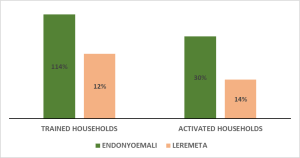
Figure 1: Households training and activation performance by village relative to targets.
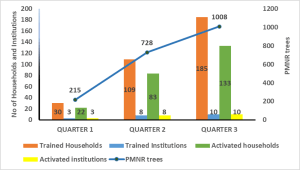
Figure 2: Quarterly progress for households, institutions and PMNR trees.